Members of Parliament have raised a red flag after learning that a single entity is lined up to take the lion’s share of funding to the Ministry of Trade, Industry and Cooperatives.
The sharp imbalance proposed in the FY 2026/27 budget for the ministry will see the Uganda Development Corporation (UDC) allocated Shs422.35 billion equivalent to 82 percent of the budget, leaving other critical institutions underfunded.
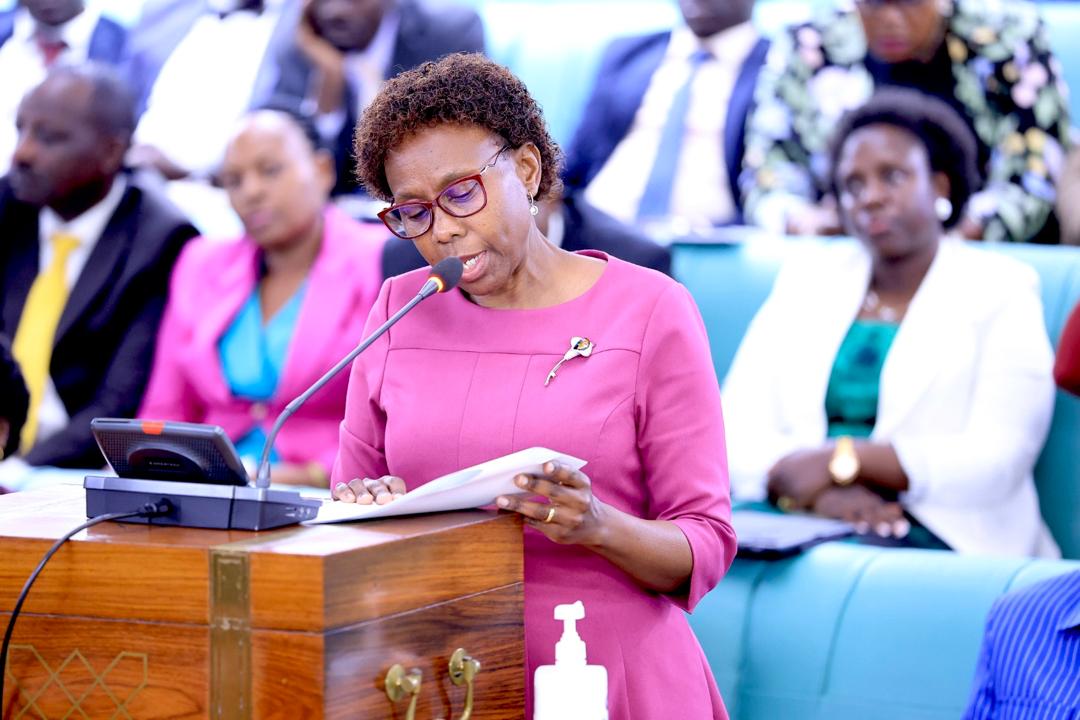
According to the report of the Committee on Tourism, Trade and Industry presented during plenary on Wednesday, 15 April 2026, the Deputy Chairperson, Hon. Boniface Okot, said although the ministry’s budget has risen to Shs514.96 billion, only Shs92.6 billion will be availed to the other votes.
“The committee notes that the increase in the ministry budget is largely driven by the capitalisation of UDC, which takes the largest share of the allocation,” Okot told the House, in a sitting chaired by Speaker Anita Annet Among.
He warned that this concentration of resources risks weakening the broader trade and industrial ecosystem, as institutions responsible for standards, research, export promotion and enterprise development are left to operate within tight financial limits.
The committee report shows that the remaining Shs92.6 billion is expected to fund the ministry headquarters, the Uganda National Bureau of Standards (UNBS), the Uganda Industrial Research Institute (UIRI), the Uganda Free Zones and Export Promotion Authority (UFZEPA), and other sector interventions including support to cooperatives and local governments.
“This level of concentration in one vote may limit the effectiveness of other institutions that are essential for trade growth and industrialisation,” Okot said.
The imbalance is already manifesting in critical gaps within the sector.
Parliament heard that despite government’s push for industrialisation, the UIRI mandated to support innovation and value addition is operating below capacity.
The committee found that UIRI’s flagship facility in Namanve remains under utilised due to lack of key machinery worth about Shs6.2 billion, constraining its ability to support industries with technology development and product testing.
Lawmakers noted that this presents a contradiction in policy implementation, where substantial resources are channeled into industrial investments through UDC, while a key institution required to sustain industrial growth remains underfunded.
UNBS continues to face funding gaps that limit enforcement of standards and public awareness on certified products, while UFZEPA has come under scrutiny for rising operational costs, including a sharp increase in legal expenses.
At the policy level, the ministry headquarters is also operating with limited resources despite its central role in coordinating trade, cooperatives and industrial development programmes.
Beyond the trade docket, Parliament highlighted imbalances across the wider tourism, trade and industry sector.
The committee noted that the Tourism Development Programme is projected to receive only about 71 per cent of its planned allocation under the National Development Plan, raising concerns about the country’s ability to fully exploit tourism as a source of foreign exchange and employment.
Similarly, allocations to local governments for trade and tourism development were found to be both inadequate and unevenly distributed, with some districts receiving minimal funding that lawmakers said is unlikely to deliver meaningful impact.
The committee also pointed to persistent systemic challenges affecting the sector, including low absorption of funds due to procurement delays, weak planning, and gaps in compliance such as delayed submission of gender and equity certificates. It further noted limited follow-up on previous recommendations, particularly those arising from the Auditor General’s reports.
Despite acknowledging the importance of capitalising UDC to drive industrialisation, the committee cautioned that the approach must be matched with balanced investment across the entire value chain.
The Speaker, Anita Annet Among, questioned if UDC should not have its own vote instead of having a subvention.
“UDC should be able to take charge, not just be instructed and give their own opinion on the institution that is to be given money.” Among stated.
Okot, who responded in the affirmative, stated that UDC has significant investments but with very low returns on investments.
The report which now moves to the Budget Committee is expected to guide debate as Parliament considers approval of the national budget for the 2026/27 financial year.